
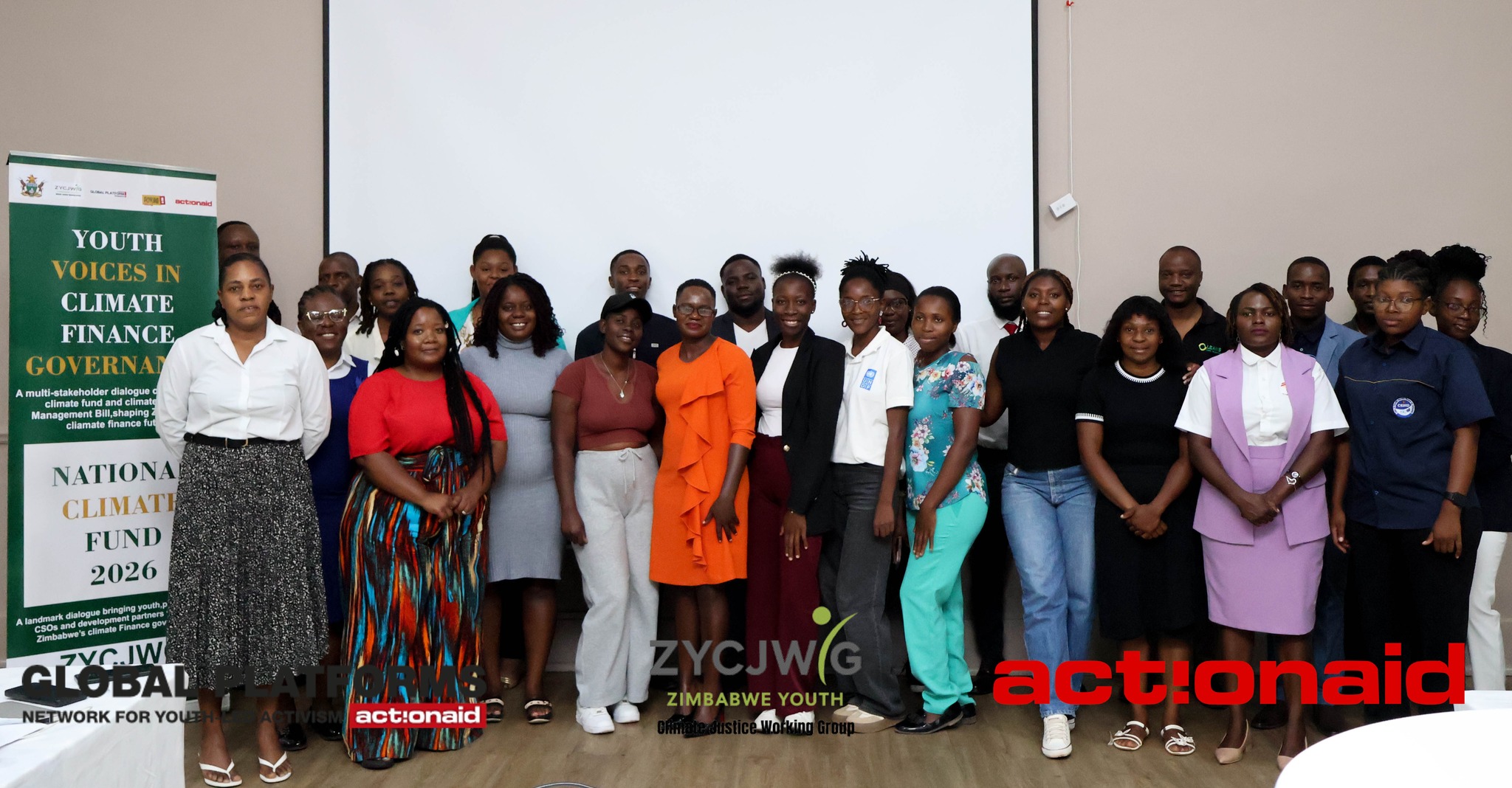
Young people convened for a National Climate Fund Youth Dialogue to discuss Zimbabwe’s proposed Climate Change Management Bill and its financing mechanism, the National Climate Fund.
The dialogue was organised by the Zimbabwe Youth Climate Justice Working Group, with support from ActionAid Zimbabwe, bringing together youth representatives, civil society, and government officials to reflect on the fund’s structure and inclusivity.
Opening the dialogue on behalf of the Ministry of Environment, Climate and Wildlife, Lovemore Dhoba, Deputy Director in the Climate Change Management Department, described climate change as a lived reality in Zimbabwe. He noted that rising temperatures, erratic rainfall, prolonged droughts, and extreme weather events are already affecting food security, water availability, biodiversity, and livelihoods, particularly for vulnerable communities.
At the centre of discussions was the proposed National Climate Fund, a financing mechanism within the Climate Change Management Bill designed to mobilise resources from government, the private sector, carbon markets, and international climate finance.
Dhoba commended participants for focusing on the fund, describing it as central to the bill’s effectiveness, and urged young people to remain actively involved in shaping climate governance processes.
“The moment you fail to play your role, that’s when you see yourself crying foul… if you leave that space void, then we are always there to occupy it again.”
The bill outlines a governance framework that seeks to integrate climate change into national development planning and budgeting. It also proposes systems for measuring and reporting greenhouse gas emissions, alongside institutional mechanisms such as oversight of carbon markets. Provisions on compliance, emissions standards, and gender integration are also included.
Currently before Parliament, the bill has undergone its first and second readings, with further amendments expected. Government anticipates that it could be enacted into law before the end of the year.
The dialogue comes as stakeholders continue to provide input into the finalisation of the bill, particularly on how the National Climate Fund will be structured and implemented.
The outcomes of the dialogue are expected to contribute to ongoing discussions around the design and operationalisation of the National Climate Fund.