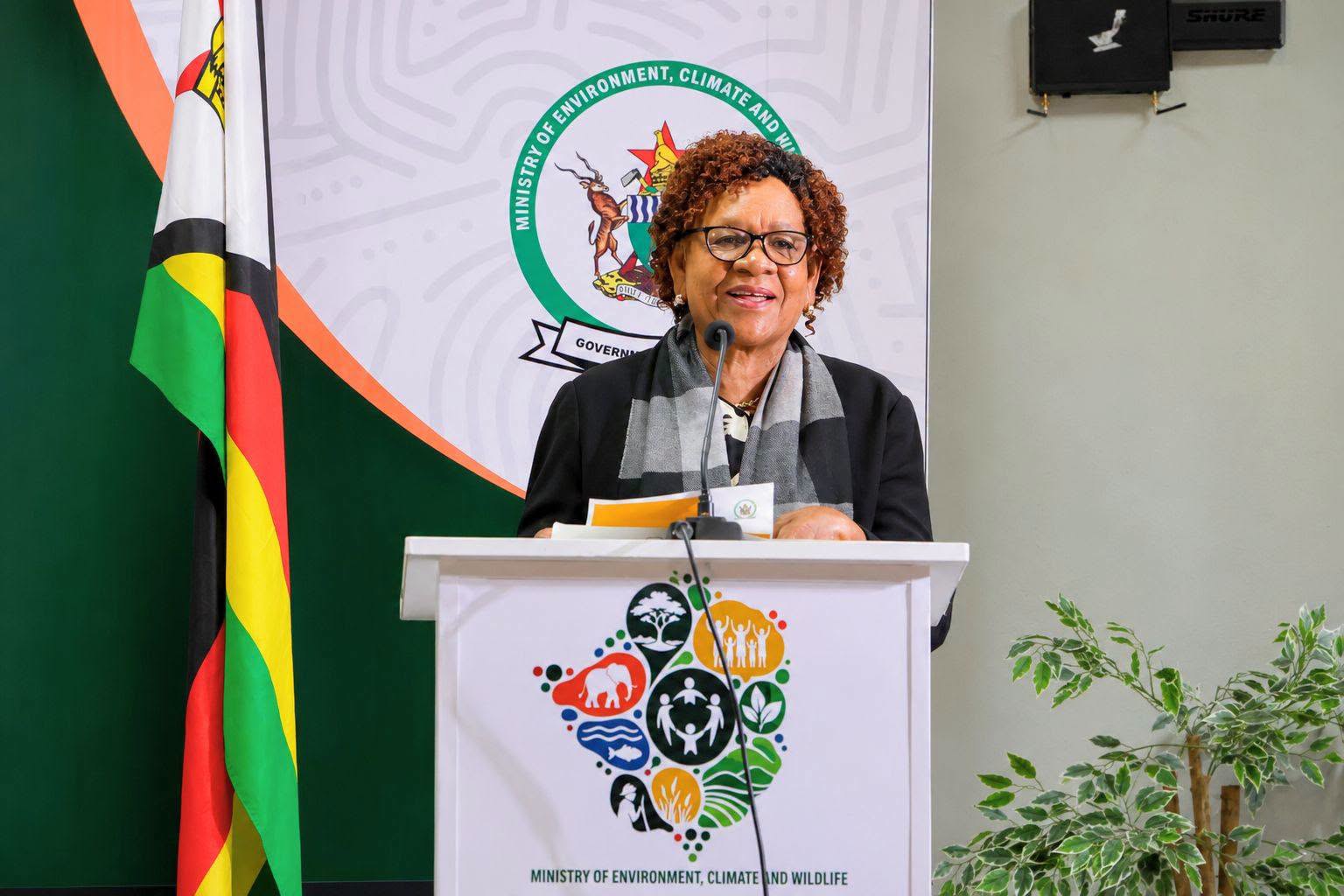
“Community conservancies, when managed sustainably, become engines of rural development, providing income, employment and social services while simultaneously preserving ecosystems for future generations,” Environment, Climate and Wildlife Minister Dr. Evelyn Ndlovu said at the Annual National Convention on the Future of Community-Based Natural Resource Management (CBNRM).
Addressing delegates, Dr. Ndlovu said empowering local communities to manage natural resources is key to ensuring equitable benefit-sharing, safeguarding biodiversity and building resilient local economies.
The convention, convened by the Ministry of Environment, Climate and Wildlife, brought together government officials, traditional leaders, local authorities, conservation organisations, civil society and development partners to discuss the future of community-led natural resource management in Zimbabwe.
It was organised in partnership with the Zimbabwe Environmental Law Organisation (ZELO), WWF Zimbabwe, Maliasili, the Zimbabwe Parks and Wildlife Management Authority (ZimParks), the Forestry Commission of Zimbabwe and the Environmental Management Agency (EMA).
Community-Based Natural Resource Management is a conservation model that empowers local communities to manage wildlife and other natural resources while sharing in the benefits derived from their sustainable use. By linking conservation with rural development, the approach helps reduce human-wildlife conflict, strengthen livelihoods and encourage communities to become long-term custodians of the environment.
Dr. Ndlovu described CBNRM as “not merely a policy approach, but a philosophy that places communities at the centre of conservation.”
“Communities are not passive recipients of conservation policies, but active custodians of Zimbabwe’s rich natural heritage,” she said.
The minister also highlighted key policy frameworks supporting conservation, including the Zimbabwe Parks and Wildlife Amendment Act, the National Wildlife Policy and the newly developed Human-Wildlife Conflict Strategy, which seeks to address the challenges faced by communities living adjacent to protected areas.
Delivering welcome remarks on behalf of the Minister of State for Harare Metropolitan Province, Mrs. G. Denhere called for CBNRM to extend beyond rural communities to encompass urban and peri-urban ecosystems, including Lake Chivero, wetlands, rivers and green spaces.
“Conservation succeeds when communities are active custodians rather than passive beneficiaries,” she said.
Opening the convention, Director of Monitoring and Evaluation Mr. Masoka, representing Permanent Secretary Mr. Masanga, underscored the Ministry’s commitment to evidence-based planning and strengthening community participation in natural resource governance.
The convention attracted representatives from government ministries, Parliament, traditional leaders, local authorities, conservation agencies, civil society organisations and development partners. Among those in attendance were Hon. Sam Matema, Chairperson of the Parliamentary Portfolio Committee on Environment, Climate and Wildlife, Chief Chundu of Hurungwe and Chief Ngungumbane of Mberengwa.
Delegates agreed that stronger collaboration among government, communities, traditional leaders, conservation organisations and development partners will be critical to strengthening community-based natural resource management and advancing Zimbabwe’s Vision 2030 of an empowered, prosperous and environmentally sustainable nation.