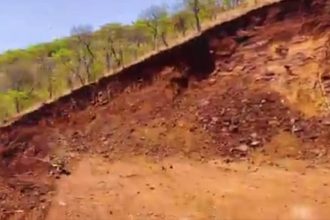

The Environmental Management Agency (EMA) has urged Parliament to declare acid mine drainage affecting the Deka River in Hwange a national environmental disaster, arguing that the decades-old pollution problem requires substantial government funding and coordinated intervention beyond routine enforcement measures.
In a briefing presented to the Parliamentary Portfolio Committee on Environment, Climate and Wildlife on 27 July 2026, EMA said historical acid mine drainage (AMD) from abandoned underground workings at Hwange Colliery remains the principal persistent source of pollution affecting sections of the Deka River.
According to the agency, mine water accumulated in underground workings abandoned after mining ceased in the 1960s. Over time, the water reacted with sulphide-bearing material before migrating through geological faults and old exploration boreholes, with the problem becoming evident during the 1990s. While Hwange Colliery has plugged some boreholes and established passive wetland treatment systems, EMA said the acidic, metal-rich discharge continues to affect parts of the river.
However, the agency sought to dispel claims that the entire Deka River is polluted.
“Monitoring consistently identifies historical Hwange Colliery Acid Mine Drainage from MTN 28 as the principal persistent water-pollution source,” EMA told the committee, adding that the pollution follows the Sikabala–Runduwe tributary before entering the Deka River.
The agency said routine monitoring conducted between 2021 and 2025, together with a June 2026 longitudinal survey, found that pollution is confined to a defined section of the river rather than its entire length.
According to EMA, water quality improves downstream through dilution, buffering and natural processes that reduce acidity and iron concentrations. However, manganese remains elevated over a localized stretch of generally 10 kilometres or less during the dry season, making it the most persistent indicator of the historic pollution.
Biological monitoring also confirmed the chemical findings. EMA said aquatic biodiversity was reduced within the affected section but improved both upstream and farther downstream, indicating gradual ecological recovery beyond the impacted reach.
The agency defended its enforcement record, saying it has actively regulated pollution within the Deka catchment through inspections, environmental audits, sampling, Environmental Protection Orders (EPOs) and prosecutions where necessary.
Between 2011 and 2026, EMA recorded 41 tickets and 37 Environmental Protection Orders against companies operating within the catchment. Of the 41 tickets issued, 31 related to effluent pollution, while assessed penalties totalled US$57,600 and ZWL3.44 million.
EMA maintained that these enforcement measures have successfully addressed illegal discharges from several operators but acknowledged they cannot resolve the historical acid mine drainage problem on their own.
“The outstanding challenge is the historical AMD source, which requires sustained treatment, specialised technical support and substantial financing beyond enforcement alone,” the agency said.
To address the long-standing pollution, EMA asked Parliament to support several interventions, including declaring the Hwange acid mine drainage a national environmental disaster to unlock additional resources.
The agency also called for the release of Carbon Tax revenues to capitalise the Environment Fund, saying the funds, currently channelled into the Consolidated Revenue Fund, should instead finance environmental rehabilitation as envisaged under the Environmental Management Act.
Other recommendations include passing the proposed Environmental Management Agency Amendment Bill, 2026, which seeks to introduce stronger deterrent penalties and reinforce the polluter-pays principle, as well as significantly increasing EMA’s technical capacity for environmental monitoring, laboratory analysis and pollution fingerprinting.
Beyond water pollution, the briefing also highlighted deteriorating air quality in Hwange. EMA reported elevated particulate matter (PM₁₀) concentrations around residential areas and haul roads, attributing the pollution to thermal power generation, coke ovens, coal mining, coal processing activities and dust from heavy vehicle traffic.
While noting progress by some industries in installing pollution-control technologies and dust suppression systems, EMA said continued monitoring and stronger emission controls remain necessary to protect surrounding communities.
The agency concluded that although the pollution pathway has been clearly identified and downstream recovery is evident, long-term remediation will require a coordinated programme combining engineering solutions, legal accountability, sustainable financing, environmental monitoring and rehabilitation.